

A post-apocalyptic party
Norwegian conteporary dancers investigates how it is to loose it all

You may have seen the picture from 2016. It shows a bunch of drunk people on a Manchester street on New Year's Eve.
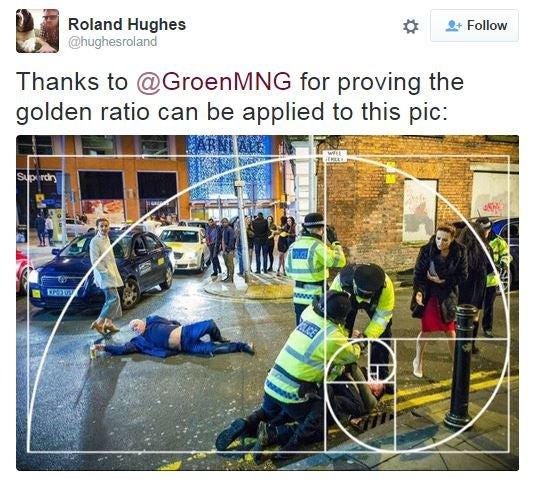
As Hughes writes, the picture had so much drama in one place. The best part? Aesthetically, the golden ratio could be applied to it.
Loosing it all
The picture came to mind when revisiting my reviewer notes on the dance performance Jeg brakk. It premiered at BIT Teatergarasjen on Saturday 23. November 2024. In Bergen, Norway, that is.
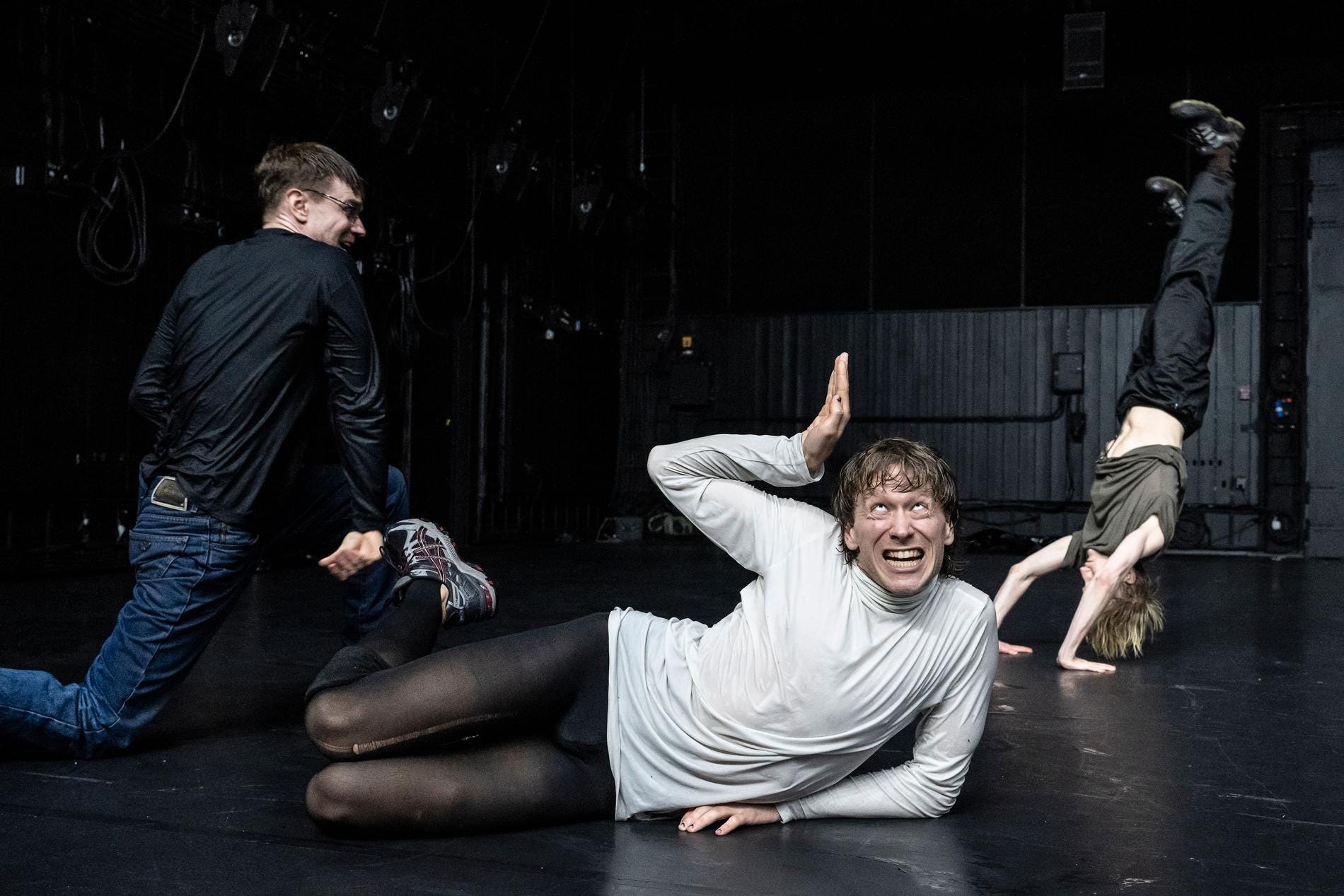
Translating the Norwegian title "Jeg brakk " is not straightforward. It might be "I broke down", "I snapped", or "I went into pieces".
To explain to the readers of Bergens Tidende how the performance made me feel, I wrote that the dancers resemble people who are completely lost after an overly damp Christmas party, now going into pieces and draining into the streets.
The lazzarone moves
When investigating the movements of "snapping," "breaking," or "going into pieces," choreographer Ole Martin Meland explained in an after-talk that he and the dancers had set out to discover what it means to be a "lassis".
The word is Norwegian slang derived from the Italian 'lazzarone'.
In other words, the starting point is the body language of the poor and downtrodden people we often see in parks, as in Vågsbunnen in Bergen and the environment around Korskirkeallmenningen.
In the talk, they expressed an interest in investigating the outsider’s sense of freedom.
I must admit I am not following on that path. It's probably overly romanticising to think that being a pauper implies a kind of freedom.
In reality, being poor has very little to do with being a free person.
That said, the performance was indeed entertaining and intriguing. I feel rich having seen it.
Professionals
Ole Marting Meland dances himself in the performance with Irene Theisen, Sebastian Biong, Aslak Nygård, and Charlott Utzig. They are all professional dancers, and I love how they investigate the bodily moves in their production.
And of course, this performance also differed from what goes on in the streets.
In the beginning, when the dancers enter the stage soaking wet, you might wonder what wet hole they've climbed out of in the ground. The fact that two dancers have white pupils as if they are zombies, emphasises the feeling of being in the time after the disaster.
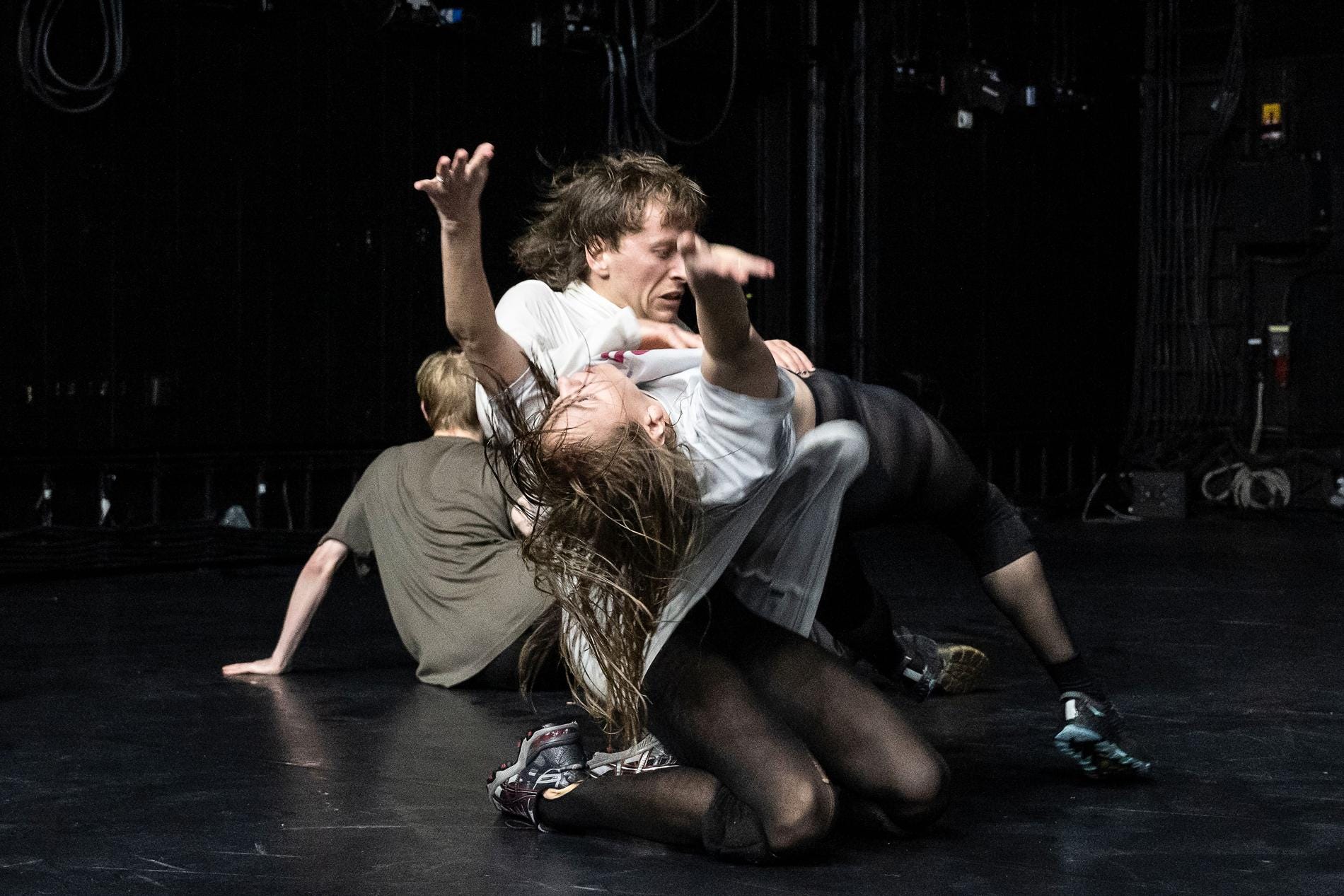
The performance resembles being virtually cultureless in a post-apocalyptic landscape. Because the black space has been stripped down, Gunnar Innvær's beautiful sound work comes into its own. Sometimes, it is noisy. Sometimes, it is quiet, as the soundscape drips and trickles as a moped occasionally whizzes past in the distance.
Silje Grimstad's simple lighting design is elegant. It sets off various urban moods, from the light that makes everything neon white to the many square lamps that make a long and stagnant sequence feel like you're in a shelter.
In this way, the performance points beyond being a lassis towards being wholly lost in a more general sense: lost in the world, lost in history, almost lost on the edge of civilisation.
Yet the performance is funny rather than tragic. The movements are full of life and will. Since antiquity, strange body movements and unheard body sounds have been associated with comedy rather than tragedy.
That's why something life-affirming in this performance fascinates me. As we know, when you're starting from scratch, the only way is up. That's enough to make you an optimist.